Showing posts with label cloth diapers. Show all posts

July 11, 2014

Cloth Diapers - the Dirty Details


So now that you have your cloth diapers, what do you do with them when they are dirty?

You can either use a trash can with a washable liner, or a wet bag, which is a waterproof, washable bag.  I have two wet bags that hang from the doorknob in Xander's room that I cycle through.  They hold 12-15 diapers, which is about two days worth for me.  I don't zip the bag up because I have heard that it is less stinky if the diapers are exposed to air, and believe it or not, I never can smell an odor unless I put my nose right up to the bag!

With wet diapers all you have to do is pull the insert out and put the whole thing in the bag.  The same applies for dirty diapers if your baby is exclusively breastfed (no solids, no formula) because their poo is water soluble, it just washes right out in the washer and won't clog your pipes or anything.  Once your baby has started solids or if your baby is formula fed, you have to dump their poo in the toilet before washing the diaper.  With Xander it most of the time just plops off, but if not, the diaper sprayer comes in very handy.  This is a little hose with a sprayer that attaches to your toilet that is used to get the poo off the diaper.  Once it is mostly cleaned off, I spray it with BacOut which is a natural enzyme cleaner, and put it in the wet bag until wash day.  The BacOut isn't necessary, but I think it helps keep the diaper from staining, plus it smells good, which is always a plus when dealing with dirty diapers. Once the wet bag is full, usually every third day, I dump the entire contents plus the bag itself into the washing machine to wash.

Here is where it gets tricky because your wash routine and detergent is going to differ depending on if you have hard or soft water, what kind of diapers you have, what cycles your washing machine allows, etc.  But generally people have the most luck with a short cold wash or rinse with no detergent to get the ick out, then a long hot wash with detergent for sanitizing, followed by an extra rinse to make sure there is no lingering detergent in your diapers.  Then most can go in the dryer if you prefer.  I like to hang dry the covers on a drying rack and put the inserts in the dryer.

A word on detergents: people will say you need to use a "cloth diaper safe" detergent, but I think that is bunk.  Detergents made for cloth diapers are typically not very strong, and are pretty expensive and hard to find (you have to order them usually) and many people have stink or ammonia issues when using them.  A lot of cloth diapering mamas are interested in natural cleaners, which makes sense because a big draw of cloth diapers is fewer chemicals for baby.  But I just am VERY skeptical that any natural cleaner can get your diapers clean enough.  We are talking about pee and poop here - you need a strong detergent to get the bacteria out.  I have seen lots of moms having trouble with their babies getting bad rashes in the diaper area, and unless it's an actual allergy to the detergent or the type of fabric the diaper is made out of, which can happen, I think it is often because the diapers aren't getting clean enough.  I am a huge Tide fan myself, and as far as standard detergents go, it is usually the most recommended.  I have soft water, so I use HE original powder because it washes out easier.  I used to use the BumGenius brand detergent and it left the diapers smelling strongly of ammonia.  As soon as I switched over to a mainstream detergent, that problem went away.  You can use any standard detergent as long as it doesn't have fabric softener in it; fabric softener coats the cloth, making it unable to absorb.

Another pet peeve of mine is when people will say to use LESS detergent if you are having issues.  The theory behind that advice is that you could have detergent build up on your diapers.  I don't know the science behind it so I suppose it could happen, but it just does not make logical sense to me to use less detergent on diapers because of stink problems.  If your baby is getting a rash or your diapers stink or smell like ammonia, it is probably because they aren't getting clean enough!  Use the recommended amount for the load size, or even a little more since diapers are heavily soiled. A tablespoon or less of detergent just isn't going to cut it.  I fill the scoop to line 2 which is the recommended amount for a medium load.

So anyway, if you are using a small amount of a cloth safe detergent and it is working for you, then by all means, keep on!  If it works don't change it.  But if you are having issues with your diapers, go mainstream! My diapers smell good and I can rest assured that they are getting clean.

Well I think I have rambled on about cloth diapers enough.  Thanks for indulging me!


June 15, 2014

Cloth Diapers - The Options

There are so many options when it comes to cloth diapers, and everybody seems to like a different combo for their babies.  Here are the main types.


First is a prefold/flat with a cover.  This is a square, flat piece of cloth that you have to fold, pin on, and then attach a waterproof cover over the top.  This is generally considered the most economical method, since flats are cheap and you can reuse the covers for a couple of diaper changes before they need to be washed.  It also has the biggest learning curve as you have to learn how to fold it and attach it to fit your baby.


Second is a fitted diaper.  This is a diaper that snaps on, no folding required, but is not waterproof, so needs a cover on top.  These can be very absorbent and good for nighttime use, but they are quite bulky.


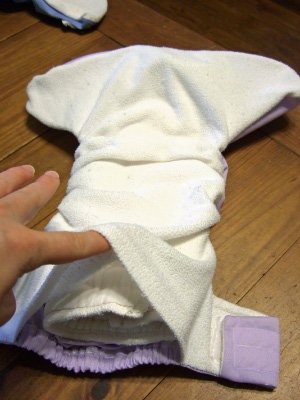
Third is a pocket diaper.  This is a diaper cover that has a fleece or stay dry pocket sewn in.  An insert is tucked into the pocket, which holds it in place.  The insert absorbs the liquid, and the stay dry fabric goes against baby's skin and wicks the moisture away so they don't feel as wet.  These are very simple to use, but the downside is you have to stuff the inserts into the pockets.

Fourth is an All-In-One diaper.  This is exactly how it sounds: one whole diaper ready to go, no stuffing or folding required.  The absorbent part is sewn in.  It's the easiest diaper to use, but you can't adjust the absorbency very well, so if you have a heavy wetter, you can't just slip another insert in.  They also take longer to dry.


The last one is a hybrid diaper or All-In-Two which is kind of a cross between a cover and an All-In-One.  These usually have an insert that snaps or lays into the cover, and the cover can be reused for several diaper changes.

I have tried all of these diapers except the prefold or flat, and they all have pros and cons. I currently have pockets, all-in-ones, and hybrids in my stash. I like pockets because you can customize the absorbency by changing the type of insert or adding an extra insert.  All-In-Ones are super easy, no stuffing required.  They both go on just like a disposable diaper, so anybody can do it.  I also prefer the inside of the diaper to be made out of a stay-dry fabric like micro-fleece or suede cloth instead of cotton because it wicks the moisture away from baby's skin and helps them not to feel like they are sitting in wetness all the time.  Xander doesn't seem to mind either way, but I just don't like the idea of wet fabric constantly against his skin.

My three favorite brands are Sunbaby, BumGenius, and Charlie Banana.


 Sunbaby is cheap, has adorable prints, and fits Xander the best.  They aren't as good quality as the more expensive diapers, but for a cheapie brand, I like them a lot.  They have held up very well so far.  They have soft fleece on the inside too, which I like.


BumGenius is a very popular brand with gorgeous colors and lots of options.  These have been my go-to diapers for naps or outings because they rarely ever leak.  My only complaint is they are very wide in the crotch, so when Xander was little and had skinny legs, they were very bulky and didn't fit very well.  Now that he is bigger they fit great.


Charlie Banana is skinny in the crotch and very stretchy, so they fit him very well when he was smaller.  They are also super soft and trim underneath clothes.  Instead of snaps in the front to make the diaper bigger or smaller, they have adjustable elastics, which eliminates the bulk that usually comes from the diaper being snapped up to make it smaller. My complaint with them is that they are so skinny that it is hard to find an insert that fits in it other than the Charlie Banana brand, which is microfiber.  I much prefer bamboo inserts.


Speaking of inserts, there are many different kinds.  Diapers usually come standard with microfiber inserts.  Microfiber absorbs quickly and holds a lot of liquid.  However, when under pressure (like baby sitting in a car seat), it leaks, and has a tendency to hold stink.  On top of that, you cannot put microfiber directly against baby's skin because it is SO absorbent that it will dry out your baby's skin. Because of this, it is my least favorite kind of insert.

Hemp and bamboo both hold a LOT of liquid, but typically absorb it slower than microfiber, meaning if your baby pees a lot all at once, it might not be fast enough to keep up, resulting in leaks.  Cotton can hold a lot as well, but it doesn't wick the moisture away from the baby's skin, so the baby will feel wet when he has a wet diaper if the insert isn't underneath a layer of stay-dry fabric like fleece.  Some babies are sensitive to the wet feeling and some aren't.

My favorite is a bamboo/microfiber blend like the charcoal bamboo pictured above.  A layer of bamboo on the outside, and several layers of microfiber on the inside.  They are very absorbent and not prone to compression leaks.  Plus, if you are so inclined you can put them directly against the baby's skin.

There are SO many options out there, and every baby is different.  If your baby is small, you'll want a skinnier diaper like Charlie Banana.  If he is a heavy wetter, you'll want to add a second insert or go with bamboo.  If your baby is allergic to synthetic fabrics (yes, I've heard of that happening), you'll want something that is cotton or bamboo against baby's skin.  Some people like Velcro while others like snaps (snaps for me!). And different combos will probably work best for your baby at different times; as they grow and develop, different brands or inserts may stop working or work better than they used to.  That's why I recommend having several different brands or styles in your stash, so you can switch out as needed.  And don't buy two dozen of one kind of diaper before your baby is born because you may end up hating it!

It has taken a lot of trial and error to find what works the best for us.  I used to be overwhelmed and frustrated as I tried to figure out what I liked, but now that I have, we hardly ever have leaks or problems, and I love cloth diapering.  Snap on a stay-dry pocket or all in one with a bamboo blend insert, and we're good to go!

My last post about diapers will be on washing, storing, and other details, and then I'm done, I promise!  :-)

June 9, 2014

Cloth Diapers - Why do it?


I really love cloth diapers.  I started doing it for various reasons, but did not expect to love it as much as I do.  It's become a bit of a hobby really; I love trying out new brands and adding cute colors and prints to my collection.  So since I love it so much I thought I'd write a series of posts about it!  (Yes, a series, because I tried to fit it all in one post and it was ridiculously long.  I am apparently just that enthusiastic about cloth diapers!)

Feel free to skip these posts if you have no interest whatsoever, because that is totally OK!  Probably makes you less crazy than I am haha.

My reasons to cloth diaper:

1.  Less chemicals on baby's skin!  Disposable diapers are made with toxic and potentially dangerous chemicals that allow them to absorb a ton of liquid and still be flat.  Usually the harmful stuff stays inside the diaper and doesn't touch the baby, but there have been cases of them malfunctioning.

2.  Good for the environment.  A disposable diaper takes approximately 500 years to decompose, and deposits human waste in landfills, where it can run off into water sources.  A cloth diaper can be used over and over again and poo gets dumped into the toilet where it belongs.  As a Christian I believe in doing what I can to take care of this wonderful earth that God made.

3.  More economical!  This was my driving factor in cloth diapering.  It costs approximately $1500-$2000 to diaper one child through potty training.  The cost of cloth varies depending on what styles you choose and how many diapers you buy, but an average estimate is $500 to fully cloth diaper one child, and if you take care of them they can easily last through more than one child.  That makes cloth diapering very very much cheaper than disposables!!  On top of that, we pay a flat amount for our water bill (unless we go over the allotted amount) and it has not increased at all since we started cloth diapering!

4.  Cloth diapers are stinkin' adorable, and so soft!  If I had to pick between wearing paper underwear or cloth underwear 24/7, I'd pick the cloth for sure. Much gentler on a soft baby bottom.

Now you know why, but how do you get started?  Part 2 coming soon.